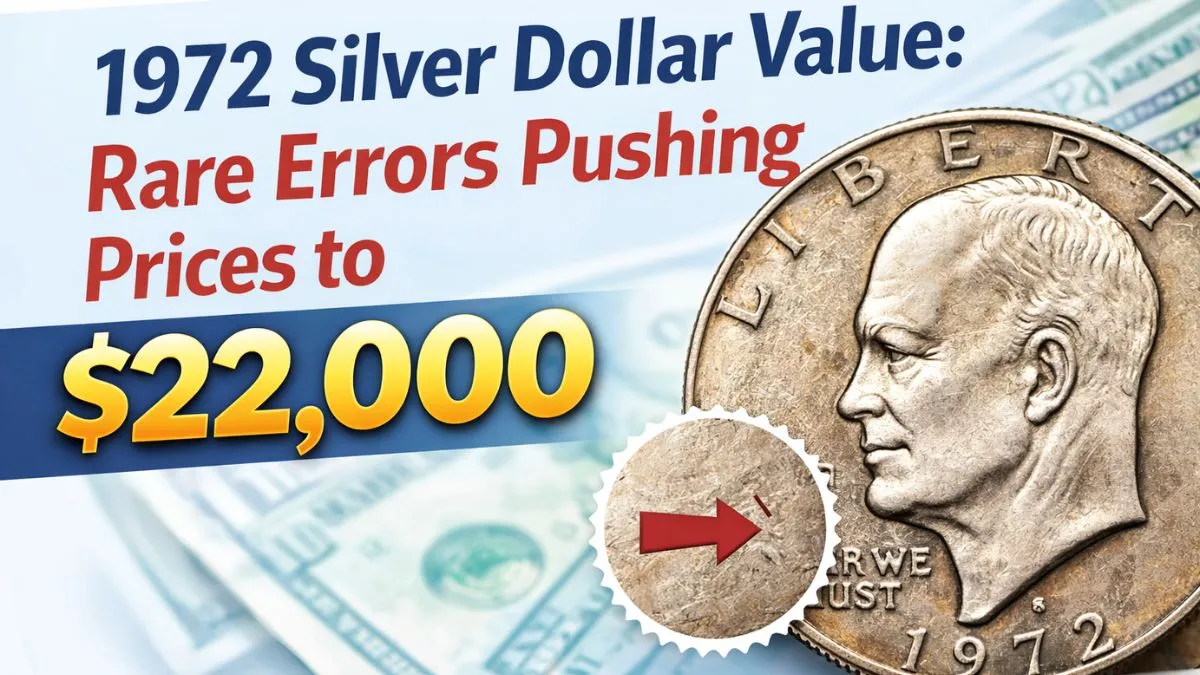
A 1972 silver dollar may seem ordinary at first glance, especially to someone who finds one tucked away in an old drawer or inherited collection. Yet within the world of coin collecting, this year has become surprisingly important. Certain 1972 dollar coins have sold for eye-opening amounts, with rare examples reaching prices close to $22,000.
These values are not driven by hype or rumors, but by real factors such as minting errors, scarce design varieties, and exceptional condition. Understanding these elements can help anyone separate a common coin from a truly valuable collectible.
Understanding the 1972 Dollar Coin
One of the most common misunderstandings is the idea that all 1972 dollars are silver. By 1972, the U.S. Mint had already moved away from circulating silver coinage. The primary dollar coin of that year was the Eisenhower Dollar, named after President Dwight D. Eisenhower. Most of these coins were made using a copper-nickel clad composition and were intended for circulation.
However, the Mint also produced special collector versions that contained silver. These silver-clad issues were not released into everyday circulation and were sold directly to collectors. This distinction is critical, as it explains why some 1972 dollars carry much higher values than others.
Different Types of 1972 Eisenhower Dollars
The 1972 Eisenhower Dollar exists in several forms, each with its own value range. Circulation strikes are the most common and usually worth only a modest amount unless they are in outstanding condition. Silver-clad collector coins contain 40% silver and are more valuable due to both metal content and lower mintage. Proof versions, struck with special care and mirror-like finishes, are also more desirable to collectors.
While these differences matter, they alone do not explain five-figure prices. That level of value is reached only when rarity and errors enter the picture.
The Three Reverse Varieties That Matter
One of the most fascinating aspects of the 1972 Eisenhower Dollar is the presence of three distinct reverse designs. These reverses show the Earth above an eagle, but subtle differences in the Earth’s details make a big difference in value.
The Type 1 reverse shows a flat and less detailed Earth and is the most common. Type 2 is scarcer and features slightly sharper details. The most valuable is the Type 3 reverse, which displays clearly defined islands and continents. Because the Type 3 was produced in much smaller numbers, collectors actively seek it out, especially in high grades.
Rare Mint Errors That Drive High Prices
Mint errors are the primary reason some 1972 dollars have sold for extraordinary sums. These errors occur during the production process and are often unique or extremely limited in number.
Double die errors, where lettering or design elements appear doubled, are among the most desirable. Off-center strikes, where part of the design is missing due to misalignment, also attract strong collector interest when the date remains visible. In rare cases, coins were struck on the wrong metal planchet, creating dramatic and valuable mistakes. Proof errors are particularly prized because proof coins are expected to be flawless, making any error stand out even more.

When one of these errors appears on a scarce reverse variety and survives in excellent condition, prices can climb rapidly, sometimes approaching the $22,000 level.
Why Condition Plays a Critical Role
Condition is one of the strongest value drivers in numismatics. A worn coin that has spent years in circulation will almost always be worth less than a sharply struck, well-preserved example. Coins graded as uncirculated or mint state retain their original detail and surface quality, which collectors value highly.
Professional grading services evaluate coins and assign standardized grades. A small difference in grade can mean a large difference in price. Many of the highest-priced 1972 dollars are those that combine rarity with near-perfect preservation.
How to Evaluate a 1972 Dollar You Own
If you believe you have a 1972 silver dollar, careful examination is essential. Start by identifying whether it is a circulation strike or a collector issue. Look closely at the reverse design to determine the variety. Use magnification to check for doubling, misalignment, or other unusual features. Weighing the coin can also help determine its composition.
It is important to avoid cleaning the coin, as cleaning can permanently reduce its value. Proper storage in a protective holder helps preserve condition while you decide on the next steps.
Why Collectors Remain Interested Today
The 1972 Eisenhower Dollar holds a unique place in U.S. coin history. It reflects a transitional period between silver coinage and modern clad currency. The combination of historical significance, multiple varieties, and genuine mint errors keeps collector interest strong. Unlike speculative trends, demand for these coins is based on documented scarcity and long-term collecting appeal.
Conclusion
Not every 1972 dollar is valuable, and most are worth far less than the dramatic figures often mentioned online. Still, certain examples truly deserve attention. Rare reverse varieties, confirmed mint errors, and exceptional condition are what push some 1972 silver dollars toward prices as high as $22,000.
Knowledge, careful inspection, and realistic expectations are the keys to understanding their true worth. For collectors and curious owners alike, the 1972 dollar proves that real value often hides in small details.
FAQs
Is a 1972 Eisenhower Dollar always silver?
No. Most are copper-nickel. Only special collector versions contain silver, making identification essential for accurate valuation.
What makes the Type 3 reverse so valuable?
Its sharply detailed Earth design and limited production make it scarce, increasing demand and long-term collector value.
Can a damaged 1972 dollar still be worth money?
Only if it has a rare error. Heavy damage or wear usually lowers value significantly, even for scarce varieties.
Does cleaning a coin increase its value?
No. Cleaning removes original surfaces and often reduces collector value. Coins should always remain in original condition.
